
Knowledge Hub
Knowledge Hub
What G1, G2 and G3 mean for a neuroendocrine cancer diagnosis – plain-language explanation of grade, Ki-67, and how they shape treatment options.

Your doctor might classify your NET as a grade according to the World Health Organization (WHO) grading system. Grading describes how tumour cells look under a microscope. It shows how abnormal the cells are and can give an idea of how quickly the tumour may develop. The grade is determined by both the mitotic count and Ki-67, which are markers of how fast the tumour cells grow and divide.
Identifying the grade of your NET helps you and your doctor create an appropriate treatment plan.
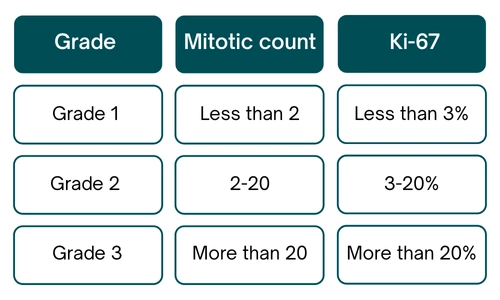
NETs are also usually divided into three groups:
The grade focuses on how the tumour cells look under a microscope, as well as how they’re dividing and at what rate.
The stage of a NET describes its size and whether it has spread beyond its original site.
Your NET may fall under one of these stages:
Both grades and stages tell your care team more about your NET cancer and which treatment may be most effective.

Could it be NETs? – Free symptom self-check
A free, anonymous, NZ-specific 3-minute symptom check. Get a printable summary to take to your GP.

Patient Guide
This booklet has been developed to provide information about neuroendocrine tumours (NETs) for patients and their families.

Types of scans for NET Cancers
There are various types of scans that may or may not be suitable for your type of NETs. Here is a summary of some scans you might encounter.

Types of Neuroendocrine Tumours
Neuroendocrine Tumours (NETs) is an umbrella name for a number of different types of tumours, which can arise in different areas of the body. It can be…